Neurological Recovery
Perispinal Etanercept in Louisville: what stroke and TBI patients should know.
Written by the clinical team at Kentuckiana Integrative Medicine · Reviewed by Dr. Rafael F. Cruz, MD

What is Perispinal Etanercept?
Perispinal Etanercept, usually shortened to PSE, is an off-label application of Etanercept, a well-established FDA-approved biologic that blocks a specific inflammatory signal called tumor necrosis factor alpha (TNF-α). In PSE, the medication is injected in a specific position in the tissue behind the spine. The patient is then placed into a brief head-down maneuver that carries the medication, via the venous plexus in the spine, into the central nervous system.
The protocol was developed by Dr. Edward Tobinick, MD, a physician in Florida who has published on PSE for more than two decades. Dr. Rafael F. Cruz, MD trained directly under Dr. Tobinick to learn the full protocol. That training lineage is rare. Most U.S. clinics offering PSE have learned it secondhand, and the technique is sensitive to exactly how the injection is placed and how the patient is positioned afterward.
What the published research says
The published research on PSE is the reason we offer it. A peer-reviewed case series of more than 600 patients, published by Dr. Tobinick and colleagues, reported clinically meaningful neurological improvement in roughly 80% of patients treated (published series, Tobinick et al.). The responses were not limited to recent strokes. Some patients treated 10, 15, even 20 years after their original stroke or brain injury showed measurable recovery in motor function, spasticity, cognition, and speech. Individual results vary.
This is unusual. Conventional post-stroke rehabilitation largely operates on the assumption that meaningful recovery plateaus in the first six to twelve months. The PSE data suggests that a chronic, low-grade neuroinflammatory state in the brain may be a significant contributor to persistent post-stroke deficits, and that dampening that inflammatory signal may reopen a window for neurological function to improve. In the published series, some effects were observed within minutes to hours of the first injection; response and timing vary by patient.
Conditions we see respond in Jeffersonville and Louisville
Etanercept is FDA-approved for rheumatoid arthritis and certain other autoimmune conditions. Its use for the neurological conditions discussed below is off-label. Off-label use is a common and lawful practice of medicine directed by a licensed physician. In our clinic in Jeffersonville, IN, five minutes across the bridge from downtown Louisville, KY, PSE is used as a supportive option for patients with:
- Ischemic stroke and hemorrhagic stroke, including patients many years post-event
- Traumatic Brain Injury (TBI) and Chronic Traumatic Encephalopathy (CTE)
- Parkinson's Disease, particularly early-to-middle stage
- Multiple Sclerosis
- Select Amyotrophic Lateral Sclerosis (ALS) presentations
- Post-stroke depression and anxiety
- Foot drop and persistent hemiparesis
- Long COVID neurological symptoms including brain fog and fatigue
For complex cases, PSE is often combined with our NEURO BRAIN Protocol: adipose-derived Messenger Signaling Cells paired with Photo-Energized PRP, delivered both perispinally and IV in the same visit. Cellular biologics of this kind are regulated under 21 CFR 1271. This information is intended for educational purposes. FDA has not evaluated these statements.
What a visit looks like
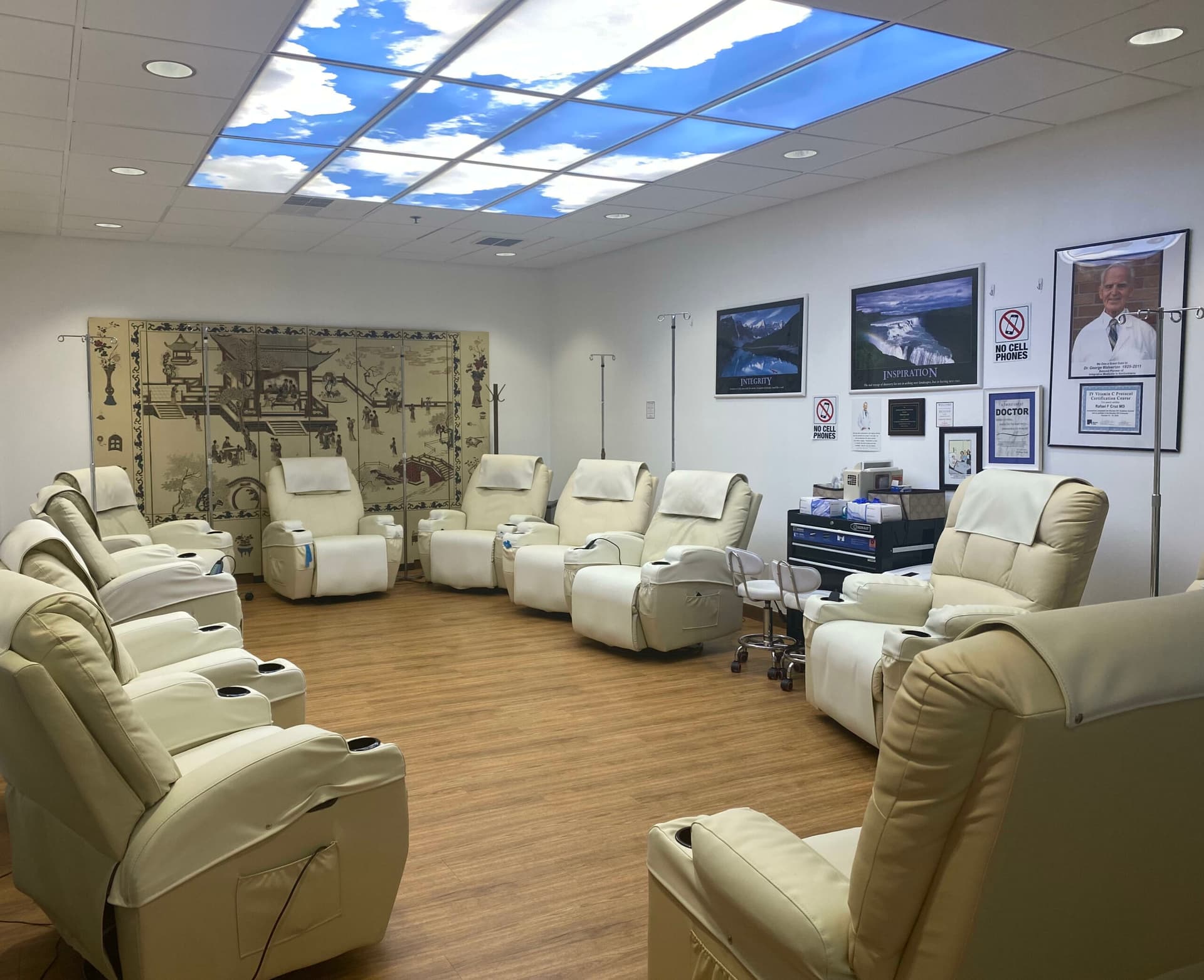
PSE is an outpatient procedure. A first visit starts with a thorough consultation and medical history, a review of imaging (MRI, CT) if available, and a baseline neurological exam so we have a clear before-and-after reference point. For most patients, the injection itself is performed the same day.
The injection is quick and generally well tolerated. Patients remain in the head-down position briefly, then return to an upright seated position. We observe you for a short period, re-examine, and document any immediate changes in speech, strength, balance, or coordination. Some patients report a shift during that first visit. A word that comes easier, a hand that grips, a leg that steps more cleanly. Individual results vary and not every patient experiences an immediate response.
Protocols vary by patient. Some respond strongly to a single round; others do best with a planned series over weeks, sometimes paired with NEURO BRAIN cellular biologics for patients with more extensive neurological damage.
Is it right for you?
PSE is not a fit for every patient. We do not administer it in the presence of active systemic infection, active tuberculosis, certain immune-compromised scenarios, or a known hypersensitivity to TNF-α inhibitors. Patients on particular immunosuppressive regimens require careful review before proceeding. These are conversations we have with every patient in the consultation, not after booking.
Realistic expectations matter. PSE is not a cure for any neurological condition. It is a tool that may, in some patients, open a measurable window of improvement. Responses can be substantial, subtle, or absent. We do not promise outcomes. We promise an honest read of your case, a clear explanation of what the research supports for a patient like you, and, if we do treat, a protocol informed by direct training under the physician who pioneered it.
If you, or someone you love, has been told that recovery has plateaued after a stroke, TBI, or neurological diagnosis, there may be more to try. Learn more about our Perispinal Etanercept and NEURO BRAIN protocol, or request a consultation.